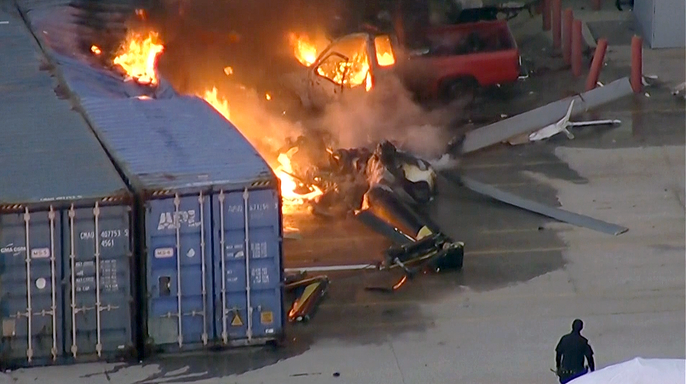
Evacuations remain in place Saturday due to a 34,000-gallon tank leaking toxic chemicals in Garden Grove, a city located in northern Orange County, California.
The leak was reported at the GKN Aerospace facility on Thursday afternoon. The tank was leaking methyl methacrylate, a volatile and flammable liquid used to make acrylic plastics, according to Orange County Fire Authority.
The potential danger prompted an evacuation of roughly 40,000 residents in multiple areas. Progress on the cleanup led to evacuation orders being lifted Thursday night; however, officials reissued them early Friday morning as crews continued monitoring chemical readings near the site.
While authorities at first seemed to get a handle on the incident, it was revealed Friday that the situation had escalated greatly overnight because crews weren’t able to fully stabilize the overheating 34,000-gallon tank containing the volatile and highly flammable industrial chemical.
This is not precautionary… this thing is going to fail, and we don’t know when,” said Orange County Fire Authority Division Chief Craig Covey in a Friday press conference. “We’re doing our best to figure out when or how we can prevent it.”
He further elaborated on the possibilities of the leak.
“We’re doing our best to figure out when or how we can prevent it. There are literally two options left remaining. One: The tank fails and spills a total of about 6,000 to 7,000 gallons of very bad chemicals into the parking lot in that area. Or two: The tank goes into a thermal runaway and blows up.”
On morning, fire officials told Nexstar’s KTLA that while they made progress overnight in stabilizing the tank’s temperature, the entire situation was in a “holding pattern” as they continue working on a final solution.
The officials’ message was still not “if” but “when” a large-scale leak or explosion would occur. While methyl methacrylate is known to be flammable and toxic, its effects on humans are not entirely known.
Covey said Saturday that the situation was still not as favorable as officials hoped for the previous day.
“Yesterday afternoon I did report that we had some positive intel — that the tanks were stable and we were keeping the temperature cool. Actually, we thought we were reducing it a little,” Covey said Saturday in a critical incident update. “Unfortunately, I have to say we ‘thought.
KTLA’s Sky5 was above the facility on Saturday morning, where camera operator/reporter Rich Prickett observed the three tanks “at the center of attention since Thursday,” and one of them appeared to have started to peel open.
“This could be the tank that has actually been compromised,” Prickett noted. “One thing that’s been working for firefighters is the cooling conditions overnight, and then of course you have the sprinkler system working overtime, and all the unmanned drones that have been keeping an eye with thermal sensors.
Covey explained that the temperature readings they were basing their reports off of on Friday were from drones gathering data from the exterior of the tanks — not the interior — so crews couldn’t measure the liquid’s exact temperature.
Crews eventually got unfortunate news when they were able to get a temperature reading. The liquid was 90 degrees, up from 77 degrees the previous morning.
Covey further elaborated on the two possible outcomes — a rupture and spill or an explosion — and the plans for each.
“Right now, one of the concepts we are thinking about is because of the heavy deluge of water and cooling it, we’re allowing it to cure at a slower rate, and reducing its overpressure,” he said, likening it to an ice cube freezing from the outside in. “While it’s doing that process, it’s building pressure — there’s a void space above the top layer of the liquid [between] the top space — we’re hoping that space can absorb a slower cure rate and not over-pressurize and blow up.”
Covey said the crew remains optimistic and that they’re consulting with people far and wide to get “additional options.
“Letting this thing just fail and blow up is unacceptable to us,” he further stated. “Our goal is to find something and not allow that to happen [and] damage our community and environment.”
A list of phone numbers and evacuation centers for affected residents, as well as a map of the evacuation zone, can be viewed below:
n addition, all Planet Fitness locations in Orange County are open to evacuees and first responders, no membership needed. Those affected can have free access to locker rooms, showers and a place to rest with access to electrical outlets and Wi-Fi.
Certain hotels in Anaheim are also offering special rates to people displaced by the Garden Grove chemical incident.
About the Author